Isaac: Hello everyone and welcome to Full Time to Travel Time, and we’ve got quite an episode for you today, don’t we, Kim?
Kim: I am so freaking excited! You guys got to hear the beginning of an epic three-month road trip Isaac and I took years ago, and you got to hear the end of it. But Isaac, like… what happened in the center? Where are all those juicy inner bits?
Isaac: A lot happened in the center, so we should dive in and talk about it. Heck yeah.
Kim: I want to hear your stories, everybody, about you taking this awesome epic road trip, because we’re about to paint it for you so you can do it yourself.
Isaac: And this road trip really was a huge influence on our lives because it was the first time that we really—like, we packed everything away. Our lease had come up at our apartment, so we packed everything away and we just went for it.
Kim: So, tell us, Isaac—where did we start this three-month road trip?
Isaac: Yeah, well the first thing was: we had to find accommodations, right? This was three months; we’d never done something to this extent before, so we needed to figure out where we were going and where we were spending the night. I remember the first night we spent was actually at a Couchsurfer residence.
Kim: That I believe I found myself, actually. Isaac is usually the navigator—he’s great at finding the best lodging. I don’t know how or why I got involved, but Isaac, I think you’re proud of the option I chose for us, right?
Isaac: So, just to explain Couchsurfing a little bit—people have heard of couch surfing, but there’s actually a website called Couchsurfing.com. On that website people can put their homes up and say, “I have a couch in my living room you can sleep on,” but they can also say, “I have a spare bedroom with a queen bed you can sleep in.”
Kim: Or say, “I have a casita you can sleep in.” It’s essentially like Airbnb, but free—with, how would you say it, good intentions in mind? Like a karma…
Isaac: Community.
Kim: Oh, that’s a great way to put it.
Isaac: So, you know, if you are doing Couchsurfing, there’s this—not an expectation, but—if you can also host people now and then, that’s really good to do. They also have meetups as well, so you can actually meet people. When you’re first doing Couchsurfing, it’s hard to get accepted because you have no reviews.
Isaac: But you can go to the meetup events they host and get reviews from those people, and that’s how we got started. We went to a few of those and started to build Kim’s profile up on Couchsurfing, so the reviews went to her. On this trip we stayed in three types of accommodations: Couchsurfing (about 15%), camping (about 15%), and Airbnb…
Kim: And—
Isaac: —Airbnb was about 70%.
Kim: Significantly cheaper back in the day as well.
Isaac: It was, but—so—
Kim: This Couchsurfer though—we were headed to Sedona. I found a Couchsurfer in Sedona named Peter, and it said, “Yeah, you can stay with me, but on one condition: you have to hike to the top of a mountain in Sedona called Bell Rock.” I came to Isaac and was like, “I found this Couchsurfer, seems like a good location, but he has a condition that we have to climb to the top of Bell Rock—okay?”
Isaac: I was like, yes—that sounds awesome. So our first day, after we packed up everything (sold most of our stuff and put the rest into storage), we filled up our car with the stuff we needed for this road trip. Then we hit the road, got to Sedona, and met Peter—who is a very interesting fellow.
Kim: Oh, he’s awesome though. He’s so fantastic.
Isaac: Peter gave us a whole tour. He’s brought over 3,000 people to the top of Bell Rock in Sedona now.
Kim: It’s probably more than 3,000 now. We were numbers like 2,671 and 2,672. We had our own numbers—I felt really cool about it.
Isaac: You can’t really hike to the top of Bell Rock without a guide. There’s no real trail, and I would never recommend anyone doing it without a guide.
Kim: Peter has done it thousands of times. He will literally tell you, “Put your foot here, put your hand here,” because it’s not a flat trail—you’re climbing a bell-shaped mountain (hence Bell Rock). What an experience.
Isaac: It was a wild experience—and a wild first day/night doing something we’d never done before, which was Couchsurfing. That was just the—
Kim: —beginning of our trip. Yeah.
Isaac: And so that—
Kim: —freaking start—
Isaac: —was pretty wild. You hike up to the top of Bell Rock with Peter and then he gives you three—
Kim: —oh, riddles. Yeah—
Isaac: —mind riddles. And he won’t bring you down until you figure out the answers to these three riddles.
Kim: You guys, I’m terrible at jokes. I’m terrible at riddles. Isaac tells me dad jokes all the time; I give him a thumbs up like, “Yeah, that makes logical sense,” and he’s like, “You’re the worst.” I’m not good at telling jokes either. Thank God Isaac was there to solve those riddles for me.
Isaac: You would have still been stuck up there on Bell Rock.
Kim: Like, I’m 70 years old—it’s been years.
Isaac: So that was our first day—pretty wild. We drove up the first day, the next day we hiked Bell Rock with Peter, and I think we stayed one more night with him.
Kim: You bet we did. I was exhausted after that.
Isaac: And then the next day, we drove to Zion.
Kim: Yeah. And remember, we’ve told you guys how awesome and epic Zion is—one of the most visited national parks as well.
Isaac: Check out our previous episode if you want to learn more about Zion—we’re not covering too much now because we’ve already talked about it. Really amazing national park. We’ve been there twice.
Kim: In that last episode we talked about Zion National Park, Kanarra Falls, Cedar Breaks National Monument. That was an awesome chunk of our trip. After Utah—well, I think this next place is in Utah too?
Kim: They’re all in Utah. They’re all in Utah.
Isaac: We stayed a week in Cedar City, then continued our road trip with the goal to get to Capitol Reef the next day. Capitol Reef National Park is one of Utah’s “Big Five.” It’s the least visited, often free to drive parts of it, and while it’s smaller with fewer established paths, there are some very, very cool things.
Kim: Oh my gosh, yeah. Imagine a giant was playing with wet sand—dripping it so it piles up into melty castles. That’s not a perfect way to describe Capitol Reef—but in red rock, not beach sand.
Isaac: There are definitely sand-castle vibes, and parts look like underground reefs—which they maybe were at one point.
Kim: We’ve been to so many places. Remember? And there’s a slot canyon there too.
Isaac: There’s a kind of slot canyon you can drive through. We didn’t do it the first visit, but on the second visit we did—it’s the only slot canyon we’ve driven through.
Kim: Do you remember driving through it? Swallows nested in the holes in the canyon walls; we had our moon roof open and they were flying back and forth. So cool.
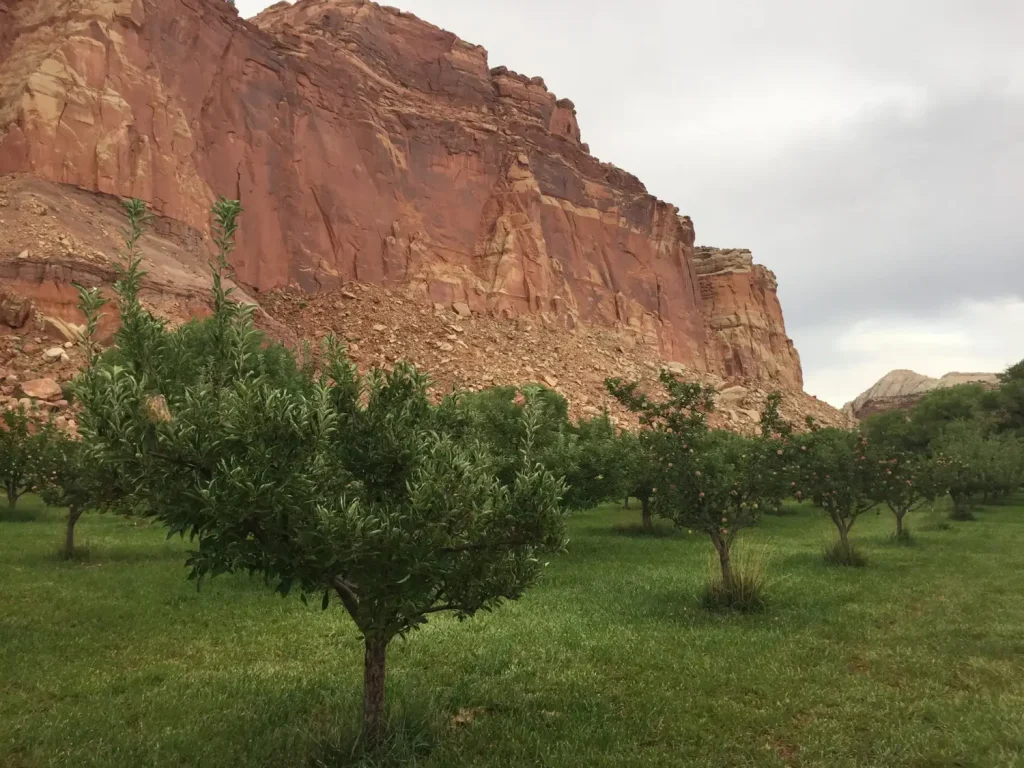
Isaac: Very cool. The first time we went, there are historical orchards—the original settler orchards that they’ve kept. When they’re in season you can eat right off the trees for free.
Kim: Or if you pick fruit to take out, you pay a little.
Isaac: Right—money’s gotta go somewhere.
Kim: We were the only people there, by the way.
Isaac: We get there and Kim’s standing at the orchard gate.
Kim: The whole orchard is caged in (to keep out animals… and maybe me). The door had a crazy contraption—a rock with a rope tied around it, a pulley around the door. I kept trying to open it; it wouldn’t.
Isaac: I walk up and Kim’s pouting. “They’re not open.” I look at the contraption and realize if I pull down on the stone, it’ll pull a lever on the other side. I pull—and the door slowly creeps open. Kim’s like, “What?!”
Kim: So we got to go into the orchard—which was awesome.
Isaac: In that same area there’s a pioneer-style shop—homemade dishware, jams, jellies, products from the orchard.
Kim: Best part: the pies. If you’re anywhere near Capitol Reef, go get yourself a pie.
Isaac: We both agree: some of the best pies we’ve had in America.
Kim: Apple pie! It was so good we had to get another after we finished the first.
Isaac: We definitely ate pie.
Kim: We love food, okay? The shop is called the Gifford Homestead—that’s where you’ll experience one of the best pies of your life.
Isaac: There’s also a campground there. And the road to the Gifford Homestead continues as Scenic Drive—it narrows into a drive-through slot-canyon-feel corridor.
Kim: Back in the day, when roads didn’t exist, people drove through slot canyons all the time—according to the signs (I read all the signs).
Isaac: Capitol Reef doesn’t have as much to do as some parks unless you have an off-road vehicle. But definitely stop at the Gifford Homestead and do Scenic Drive. And hit the orchards in season.
Kim: They’ve got all sorts of fruit—not just apples. Peaches and pears and all sorts of things.
Isaac: Oh my!
Kim: Apples and peaches and pears—oh my!
Isaac: We didn’t spend the night that first time; we just drove through. We went back years later and explored more. From there we continued to Moab. Moab reminded me of Queenstown, New Zealand—the adventure capital vibe. Two national parks and an epic state park within about 15 minutes.
Kim: I’m sure you can take a helicopter or skydive too.
Isaac: All sorts of stuff. It’s popular, and with popularity… comes booked lodging. We couldn’t get our first choice on the phone, hotels were booked, and the one with availability was ~$350/night. Hard pass.
Isaac: We found the only hostel in town: Lazy Lizard.
Kim: This is the only hostel I’ve ever experienced in my life. Isaac, how many have you done?
Isaac: About 20—lots while traveling Australia and Europe.
Kim: Isaac made it clear: hostels in America are quite different from elsewhere.
Isaac: Typically, yes. It’s not the nicest place we’ve stayed, but we got a private cabin with two queen bunk beds.
Kim: Which I hear is not normal—usually 4–8 bunks in one room with a bunch of people.
Isaac: In Moab it’s by far the most affordable place. They also have shared bunk rooms.
Kim: And you can totally camp. I opened our door in the morning and there was a tent basically at our front step—people set up everywhere. Cheap and cheerful.
Isaac: Shared bathrooms (a minute’s walk) and a communal kitchen/living area.
Kim: Nice to have community space and a kitchen.
Isaac: Overall: fine stay, not a favorite hostel, but I’m happy it exists—one of the only affordable options in town. Book ahead if you can; if phones fail, try email.
Kim: Yes.
Isaac: What’s in Moab? So much. First, I took us on a scenic drive to a spot with dinosaur tracks.
Kim: I kind of remember—big three-toed things.
Isaac: Free, with a nearby arch. Cool little hike. Next up: Arches National Park.
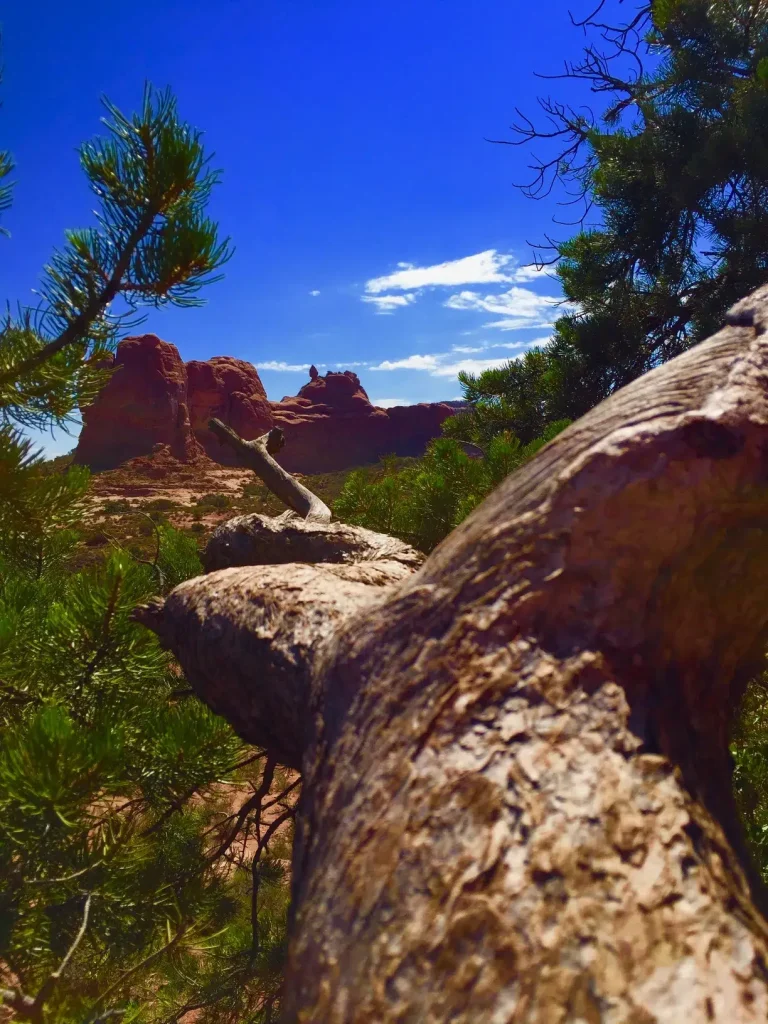
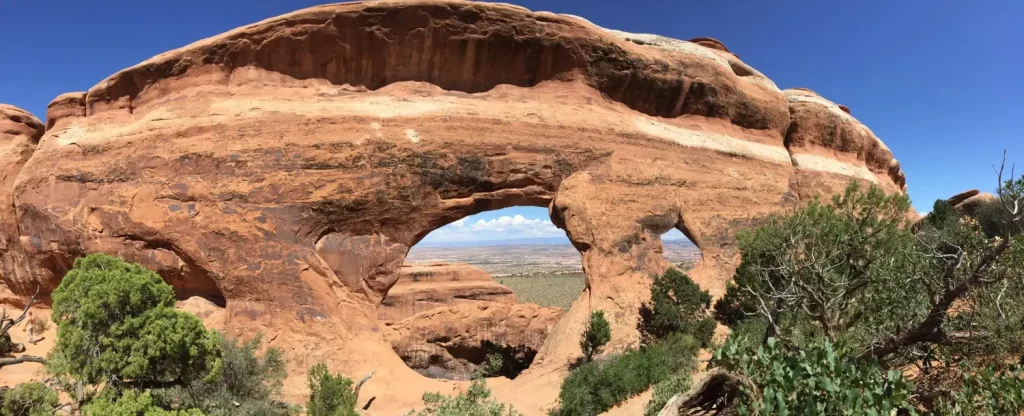
Kim: I’ve never seen arches like this in my life. We’d just seen an arch at the dino place and I was like, “Whoa!” Then Arches was like, “HOLY CRAP—nature did this?”
Isaac: It has one of the most densely collected sets of arches in the world.
Kim: I think Landscape Arch is the longest/widest? It goes on forever.
Isaac: We should double-check that fact—but it’s very long and very cool. The most famous is Delicate Arch—about a 3-mile round-trip hike. When you get there, there’s a whole queue system for photos: hand your camera to the person behind you, they shoot yours, then you shoot theirs.
Kim: It’s a surprisingly efficient assembly line. Most people are respectful—take a couple pics and move on. Sometimes folks overdo it. We waited like 20–30 minutes, but it’s worth it. Big tip: there’s no shade on the hike. We went during a really hot time—pack water and sun protection.
Isaac: One item we bring everywhere—thanks, Hitchhiker’s Guide—is a cooling towel. Always have your towel. Cooling towels make a huge difference for hiking safely in heat.
Kim: What the heck is a cooling towel? It’s a small towel—get it wet, shake it, it gets cold. It stays cool a decent time; in direct sun it’ll dry faster. Huge help. Isaac wears it as a bandana; I wear it as a scarf.
Isaac: Pack extra water just to re-wet the towels. We keep a small plastic bag to soak it without wasting water. Can’t say enough good things.
Kim: We could do a whole podcast just on cooling towels—but moving on. Delicate Arch is fantastic—put it on your list.
Isaac: Do it first thing in the morning—cooler temps and shorter photo line. After that we drove to Devil’s Garden Trailhead—you can see a bunch of arches in a single hike, including Landscape Arch.
Kim: Super incredible.
Isaac: We Googled it—Landscape Arch is the longest arch in North America with a light opening of 306 feet.
Kim: Like 93 meters.
Isaac: Very long. You can keep going farther and see more arches—just check weather and gear for heat. On our way out we hit every pullout.
Kim: Why wouldn’t you?
Isaac: It gets busy at the entrance areas, but the pullouts often have parking.
Kim: Mm-hmm.
Isaac: That was Day 1 in Moab.
Kim: Oh my gosh.
Isaac: Kim, remember the next day?
Kim: You mean where we were like tiny ants in a park with giant crevices?
Isaac: Canyonlands National Park.
Kim: Exactly. Didn’t you feel like a tiny ant in the world’s big crack?
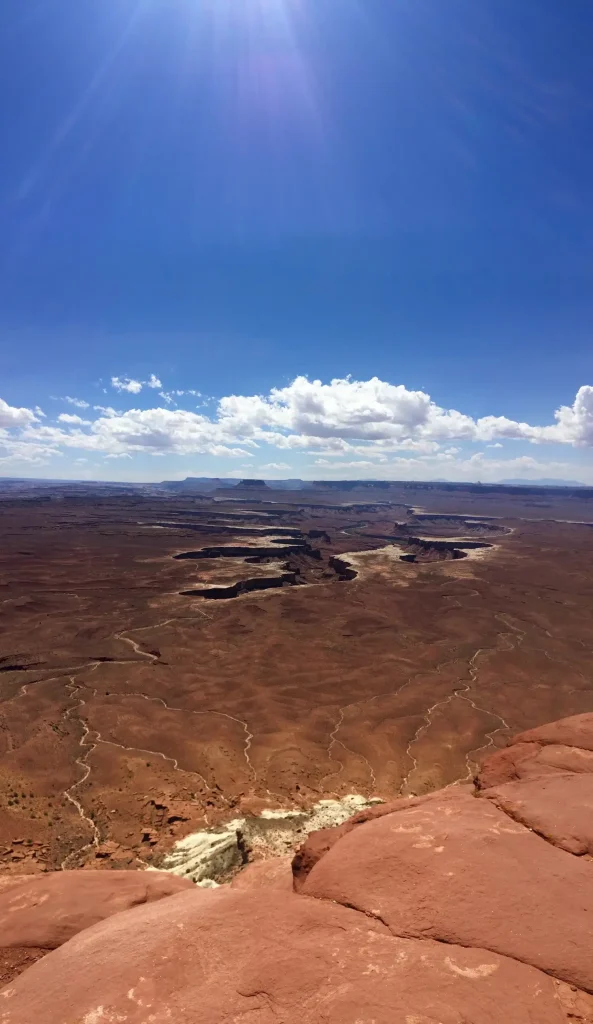
Isaac: Canyonlands is wild because you’re up on a cliff—and then looking down into canyons. A double-height situation.
Kim: You look out at a flat surface that appears to have tiny crevices—but they’re massive canyons. Like the Grand Canyon, your brain struggles to scale it.
Isaac: I don’t think I’ve been anywhere else where you look down—and then down again.
Kim: Do you remember the arch in Canyonlands?
Isaac: Mesa Arch.
Kim: It messed with my mind. In photos you can’t tell what you’re looking at—through it or at it?
Isaac: It’s a famous sunrise spot—photographers flock there.
Kim: Oh yeah—so cool.
Isaac: Do you remember the hike we did?
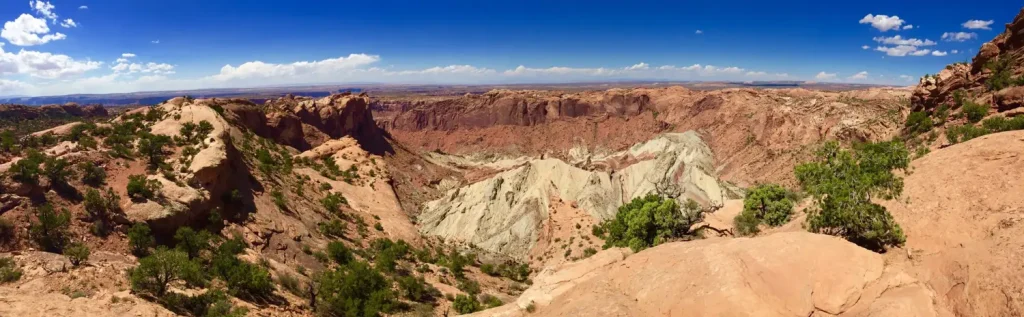
Kim: It had a weird name—Upheaval? Upheaval Dome?
Isaac: In fact, Upheaval Dome.
Kim: What does “upheaval” even mean?
Isaac: The earth was upheaved—lifted up.
Kim: Meaning I’m heaving upward? Okay, okay.
Isaac: On the way you pass Whale Rock, which looks like a giant whale.
Kim: Of course I remember the animal thing. I was on the ground; Isaac was on the whale. Because I was so much lower, when he jumped I got a perfect shot that looked like he was floating.
Isaac: I was kind of.
Kim: You were riding the whale.
Isaac: The main district is called Island in the Sky—you’re up on a high plateau. Speaking of plateaus, I compared Kim to a plateau and she got mad; I said it was the highest form of flattery.
Kim: …Because plateaus are high and flat? Right, right. Remember when I said I don’t get jokes?
Isaac: If you have to explain a joke, you nailed it. Excellent work.
Kim: Anyway—Upheaval Dome. Worth seeing?
Isaac: Very cool. It was so hot we only did half the hike; I’d love to go back and do the whole thing.
Kim: Surprisingly green, too. Canyonlands is red/brown, but Upheaval Dome looks greenish rising out from the center, surrounded by the red.
Isaac: Great descriptor. Canyonlands is huge, and much of it is hard to access.
Kim: Or inaccessible.
Isaac: Right. The main section doesn’t have a ton, but it’s still worth it; with the right vehicle there’s a lot to explore.
Kim: Totally worth it.
Isaac: After Canyonlands we headed to—
Kim: Grand Junction, yeah?
Isaac: Nope.
Kim: Where before Grand Junction?
Isaac: Dead Horse Point State Park.
Kim: Oh, snap.
Isaac: One of the most famous state parks in the U.S.—about 10 minutes from Canyonlands, so it makes sense to pair them.
Kim: It’s known as one of the most photographable spots in the U.S.
Isaac: You’re super high up, with views around Moab and canyons everywhere.
Kim: I’ve been there multiple times—thanks to my grandparents taking me when I was little.
Isaac: We did get attacked by a fly there.
Kim: Did we have to run? It kept attacking us!
Isaac: We got out of the car and a fly started attacking Kim. I stepped in front to protect her, took a swing, connected, watched it fly off—then flip in the air, stop, look at us, and beeline back. I was like, “Kim, run!”
Kim: People were watching us sprinting down the sidewalk from a fly. Yes, that happened.
Isaac: That’s our Dead Horse story. Very cool park—definitely worth checking out since it’s right next to Canyonlands.
Kim: I’m really excited for the next place we went.
Isaac: That was the next day. We spent about three days in Moab.
Kim: We did so much in three days! The adventure doesn’t stop—it’s a three-month road trip. Next day: new adventure, new place.
Isaac: We called it “the most epic drive to get birth control ever.”
Kim: Isaac called it that. I needed a refill; he said, “Let’s make an epic trip out of it.”
Isaac: Your pharmacy wasn’t in Moab, so—
Kim: We had to leave.
Isaac: We drove to Grand Junction (about 1.5 hours), but I wanted an epic route.
Kim: Not the basic road—of course not. Isaac’s like, “We’re driving through Colorado National Monument.”
Isaac: Even before that, the drive leaving Moab on UT-128 is epic. A river runs alongside you the whole way; after floods it’s a brown surge—pretty wild. People might recognize it from Westworld—the train approach to the park was filmed along there. I recognized it while watching and looked it up—yep.
Kim: I haven’t seen Westworld. Should I? Robots? Wild West? Got it.
Isaac: Very cool drive—highly recommend. Then we got to Colorado National Monument.
Kim: It’s free to drive through…?
Isaac: Free for us because we have the National Park Pass.
Kim: Fair point—get yourself the $80 pass.
Isaac: It’s the best bang-for-buck entertainment you can buy—$80/year gets you into national parks, monuments, recreation and historic sites.
Kim: Anything with “National” in it—National Wildlife Refuge, National Historic Whatever.
Isaac: We probably save ~$500/year using it. If you’re 65+, you can get a lifetime pass for a one-time $80. If you’re in 4th grade, your family gets a free annual pass.
Kim: Oprah moment: you get a pass! (Only if you’re in 4th grade.)
Isaac: If you get it—use it.
Kim: Use it or lose it! (I just wanted to say that.)
Isaac: Use it and you don’t lose it—until the year ends.
Kim: Anyway—Colorado National Monument. Some really cool things. Remember the Egyptian Mummy?
Isaac: One of the coolest formations we came across. Colorado National Monument is borderline national-park-worthy—big, tons to do, very epic.
Kim: You’ve got a paved rim road, great pullouts, the “mummy” (not a real one)—a rock formation that looks like a mummy lying in a tomb, carved by erosion. It’s nuts.
Isaac: At that same spot is one of the best echo chambers we’ve ever found.
Kim: The sign told us to try it—we didn’t make it up. It literally says, “Try yelling.”
Isaac: We went nuts—yelling, recording, beatboxing. Anytime someone else came, Kim ran over like, “You have to try this!” We stayed about an hour just playing with the echo.
Kim: There were hundreds of me’s bouncing across the canyon, hitting the mummy, coming back. So cool.
Isaac: We were tired before, then totally hyped—jumping, dancing—like happy kids. Beatboxing echo chamber!
Kim: Another cool spot: the Coke Ovens—dome formations. Reminded me of my dad (steel mill), but, yes, they also look like… boobs.
Isaac: Okay.
Kim: There were three boobs—remember?
Isaac: I think there are four—perhaps four boobs—and they all have little “nipples” on top. Anyway—Coke Ovens: worth a stop.
Kim: Off boob talk, back to birth control: we did successfully get my prescription on time. Thanks, Isaac, for planning one of the most epic road trips to get birth control.
Isaac: Ever. We stayed in Grand Junction that day. It’s a good sleepover town and staging point to head deeper into Colorado.
Isaac: If you want to learn more about Utah’s Big Five and get our personalized road trip, go to FullTimeToTravelTime.com → Pod Blog → Episode 5 to download the PDF—day-by-day, what to do, and how to hit the Big Five.
Kim: I like how you said “closely clumped.”
Isaac: Closely clumped! Awesome. Until next time—this is Full Time to Travel Time. See ya.

 Podcast
 Work With Us
 Road Trips
 Things To Do
 Shop
Shop Resources
 Travel Podcast:
 Work With Us:
 Meet Kim & Isaac
 LocalFi Marketing



 Road Trips





 Things To Do



 Resources